

Understanding Keystone Couplers, Punch-Down Jacks and Tool-Less Jacks and Plugs
Posted by Steve Bowman on Jul 17th 2023
The term “keystone” has its origins in architecture and refers to the central, wedge-shaped stone that holds the other stones in place at the top of an arch. Over time, it has come to symbolize a central or crucial element that holds other parts together or provides stability.
In computer networking, an “Ethernet keystone” is a modular connector that provides a standard interface for joining Ethernet cables to various network devices. In the same way the central stone at the apex of an arch holds all the other stones together, so does an Ethernet keystone hold network connections together.
Ethernet connections are provided to a room via a wall plate, a patch panel, or a surface-mount box. But since the many types of devices that connect with a plate, panel, or box require different types of inputs, you must have the right keystone jack or module to adapt your device. A keystone snaps into a wall plate and its ports allow you to connect a variety of low-voltage devices to an Ethernet network.
In this blog post we center on three types of keystone-products you should understand:
Keystone Couplers
A keystone coupler is a connector that allows for the extension or connection of Ethernet cables. It is designed to fit into a keystone wall plate or patch panel, providing a modular and convenient solution for networking installations. It typically has two female RJ-45 ports on each end, allowing Ethernet cables with male RJ-45 connectors to be inserted and connected. It essentially acts as a bridge between two Ethernet cables, enabling the extension of network connections or the creation of patching points.
To use an Ethernet keystone coupler, insert one end of an Ethernet cable into each of the coupler's ports. The coupler then provides a secure and reliable connection, allowing data to pass through between the connected cables.
dozens of keystone coupler options in Cat5e, Cat6, Cat6a, and even RCA. They are made out of rugged thermoplastic or metal and all are compliant with CE and/or RoHS. To help keep your connections organized, we offer them in nine colors. Our customers use them in server rooms, offices, homes, AV installations, and more. Save money by buying them in quantities of 10 to 50.
Punch-Down Keystone Jacks
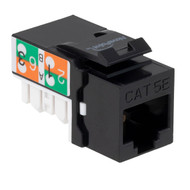
A punch-down keystone jack is designed to be mounted in a keystone wall plate or patch panel, providing a modular and flexible solution for terminating network cables. The term “punch-down” refers to the method used to terminate the individual wires of a network cable onto the keystone jack. Inside the jack, there are metal pins or contacts that correspond to each of the eight wires in the Ethernet cable. To make the connection, you use a punch-down tool, often with a 110 or Krone blade, to insert and secure the wires into the appropriate slots on the keystone jack.
The punch-down process involves placing the Ethernet cable's individual wires into their designated slots and using the punch-down tool to push the wires into place. The tool trims any excess wire and ensures a secure and reliable electrical connection between the cable and the jack.
NavePoint has 50+ punch-down keystone options in Cat5e, Cat6, and Cat6a. The terminations are color-coded to simplify installation. Get them in 90-degree or 180-degree form factors. Most are made of high-impact, fire-retardant thermoplastic and with gold-plated contacts. Get them in cost-saving packs of 10 to 50.
Tool-Less Keystone Jacks and Plugs
Tool-less Ethernet keystone jacks and plugs are connectors that simplify the installation of Ethernet cables by eliminating the need for specialized tools, such as punch-down tools or crimping tools. They provide a convenient and user-friendly alternative for terminating network cables.
Tool-less keystone jacks typically feature a snap-in design, allowing the wires of an Ethernet cable to be easily inserted and secured without the use of a punch-down tool. They often have color-coded wiring slots or labeled wire channels that correspond to the T568A or T568B wiring standards for Ethernet.
To terminate the Ethernet cable onto a tool-less keystone jack, you would strip the cable's outer jacket, arrange the individual wires according to the desired wiring scheme (T568A or T568B), and insert them into the corresponding slots or channels on the jack. The jack's internal mechanism or built-in wire management system secures the wires in place, creating a reliable electrical connection.
Tool-less Ethernet plugs work in a similar way to tool-less keystone jacks but are used for terminating the ends of Ethernet cables directly. They are designed to be attached to the stripped ends of the cable, eliminating the need for crimping tools typically used with traditional plugs.
To terminate an Ethernet cable using a tool-less plug, you would strip the cable's outer jacket and arrange the individual wires according to the desired wiring standard. The plug typically has color-coded or labeled channels for the wires, and you can insert them into the appropriate slots or channels. Once inserted, the plug's mechanism secures the wires in place for a reliable connection.
NavePont has over two dozen tool-less keystone options in Cat5e, Cat6, and Cat6a. Most are designed for use with NavePoint patch panels, wall plates, and surface-mount boxes that have standard keystone ports. They are made of metal or high-impact plastic and with gold-plated phosphor bronze contacts. Buy them in cost-saving multi-packs of 10 to 30.
***
You might start your search for Ethernet keystone jacks, keystone plugs, and keystone adapters here. We offer over 150 models, and most are in stock and available with free standard same-day shipping.
For any help or advice on what product is best for you, contact our U.S.-based NavePoint sales team at 1-866-312-5401 or email us at sales@navepoint.com.