

When Floor-Mount vs. Wall-Mount Racks Make Sense
Posted by Tim Houghton, Senior Product Line Manager, Infinite Electronics on Apr 27th 2026
Choosing between a floor-mount rack and a wall-mount rack is one of the most important decisions when designing or upgrading a network environment. The right choice affects not only how your equipment is installed today, but how easily your infrastructure can scale in the future.
Both rack types serve distinct purposes. Floor-mount racks are designed for larger, high-density deployments, while wall-mount racks provide a compact, space-saving solution for smaller setups. Understanding the differences in capacity, airflow, installation and long-term flexibility is key to selecting the right option.
Key Takeaways
- Floor-mount racks are best for scalability, heavier equipment and full-depth installations
- Wall-mount racks are ideal for space-constrained environments and smaller network setups
- Equipment depth and weight are critical factors in choosing the right rack type
- Installation environment can limit whether wall or floor solutions are viable
- Airflow and cable management capabilities vary significantly between rack types
- Long-term growth and budget should guide the final decision
When to Use Floor-Mount Network Racks for Scalability and Heavy Equipment
Floor-mount racks are the preferred choice for environments that require flexibility, expansion and support for heavier equipment. These racks are commonly used in server rooms, data centers and network environments where infrastructure is expected to grow over time.
One of the primary advantages of floor racks is their ability to support higher weight loads and full-depth equipment. Servers, UPS systems and other large hardware components require the stability and depth that floor-mounted solutions provide.
Floor racks also offer greater scalability. As network demands increase, additional equipment can be installed without needing to replace the entire rack system.
Learn more about selecting the right network rack or cabinet.
When Wall-Mount Network Racks Make Sense for Space-Saving Deployments
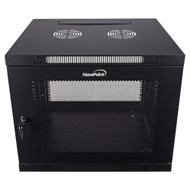
Wall-mount racks are designed for smaller installations where space is limited and equipment requirements are minimal. These racks are commonly used in offices, retail environments and network closets where floor space is not available.
Wall-mounted solutions are ideal for housing lightweight equipment such as switches, patch panels and small networking devices. They are typically quicker to install and require less upfront investment compared to floor-mounted racks.
However, wall racks come with important limitations. Depth restrictions can prevent proper installation of larger equipment such as servers, and weight capacity is significantly lower. Proper wall support is also essential, requiring installation into studs or concrete to ensure stability and safety.
Why Equipment Size, Depth and Weight Matter in Rack Selection
One of the most overlooked factors in rack selection is equipment depth. Many network devices, especially servers, require deeper enclosures that exceed the capacity of standard wall-mounted racks.
Floor-mount racks are built to accommodate full-depth equipment, allowing for proper clearance, airflow and cable routing. In contrast, wall-mounted racks are designed for shallow-depth devices, which can limit future upgrades or equipment changes.
Weight is another critical consideration. Floor racks are engineered to support heavier loads, while wall racks must adhere to strict weight limits based on mounting conditions.
Before selecting a rack type, it is essential to evaluate both current and future equipment requirements.
How Installation Environment Impacts Rack Type Selection
The physical environment plays a major role in determining whether a floor-mount or wall-mount rack is appropriate.
Wall-mounted racks require structurally sound mounting surfaces, such as reinforced walls, studs or concrete. Without proper support, installation may not be feasible.
Floor-mounted racks require dedicated floor space and may need anchoring depending on the environment. While they take up more room, they offer greater flexibility in placement and accessibility.
Airflow and Cable Management Differences Between Rack Types
Airflow and cable management are essential for maintaining system performance and reliability.
Floor-mount racks provide better airflow due to their larger size and ability to support advanced cooling configurations. This makes them well-suited for high-density deployments.
They also offer more robust cable management solutions, including vertical and horizontal pathways that improve organization and reduce strain on connections. Using components like rack shelves can improve flexibility, strength and airflow, while dedicated cable management solutions help maintain organization and system performance as networks scale.
Wall-mount racks, while more compact, have limited airflow and cable management capacity. Their smaller footprint can restrict heat dissipation and make cable organization more challenging.
How Budget and Future Growth Should Guide Your Rack Decision
Budget is often a deciding factor when choosing between floor-mount and wall-mount racks. Wall-mounted solutions typically have a lower upfront cost and faster installation.
However, floor-mounted racks offer better long-term value for growing environments. Their scalability reduces the need for replacement as infrastructure expands.
For a deeper look at how to plan for scalable infrastructure, see this guide to smart, scalable rack design.
Choosing the right rack is not just about current requirements, but also future growth and evolving network demands.
How to Choose Between Floor-Mount and Wall-Mount Racks for Your Network
The choice between floor-mount and wall-mount racks depends on space, equipment requirements, scalability and installation constraints.
Floor-mounted racks are best suited for high-density environments and long-term growth, while wall-mounted racks are ideal for compact deployments where space is limited. In some cases, selecting between 2-post and 4-post rack configurations can also help determine the right structure for your equipment and load requirements.
By evaluating equipment size, weight, airflow requirements and future expansion plans, network designers can select the right solution.
Frequently Asked Questions (FAQs)
Floor-Mount vs Wall-Mount Racks
What is the main difference between floor-mount and wall-mount racks?
Floor-mount racks support larger, heavier equipment and allow for expansion, while wall-mount racks are designed for smaller installations.
Can servers be installed in wall-mount racks?
Most servers are too deep and heavy for standard wall-mount racks, making floor-mounted racks the better option.
Are wall-mount racks safe for heavy equipment?
Wall racks have weight limits and require proper structural support, making them suitable for lightweight equipment only.
Which rack type is better for airflow and cooling?
Floor-mount racks provide better airflow and support more advanced cooling compared to wall-mounted racks.
Are wall-mount racks cheaper than floor racks?
Yes, wall-mount racks typically have a lower upfront cost, while floor racks offer better long-term value.
How do I choose the right rack for my network?
Consider equipment size, weight, space, airflow and future growth requirements.
Shop Floor-Mount and Wall-Mount Network Racks
Explore NavePoint’s full range of network racks and cabinets designed for scalability, durability and efficient cable management: