

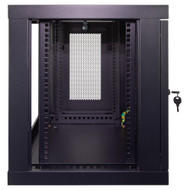
Key Considerations Before Installing a Wall-Mount Cabinet
Posted by Tim Houghton, Senior Product Line Manager at Infinite Electronics on May 28th 2026
Wall-mount cabinets provide an efficient way to organize and protect network equipment in environments where floor space is limited. They are commonly used in offices, retail locations, security installations, telecom rooms, and edge network deployments where compact infrastructure solutions are essential.
However, successful installation requires more than simply mounting the cabinet to a wall. Load capacity, airflow, cable routing, equipment dimensions, and long-term scalability all play a major role in determining whether the installation will perform reliably over time.
Choosing the right cabinet and preparing the installation environment properly helps prevent equipment issues, simplifies maintenance, and supports future growth.
Key Takeaways
- Wall structure and mounting surfaces must support both cabinet and equipment weight
- Equipment dimensions determine cabinet compatibility and clearance requirements
- Installation location affects accessibility, airflow, and maintenance efficiency
- Cable management planning improves organization and simplifies future changes
- Ventilation and cooling are critical for enclosed network environments
- Planning for future expansion helps avoid premature cabinet replacement
Why Proper Planning Matters Before Installation
Wall-mount cabinets often support critical networking, telecom, and security infrastructure. Improper installation can create long-term issues related to safety, airflow, cable congestion, and equipment accessibility.
Before installation, organizations should evaluate:
- Wall construction and mounting strength
- Total equipment weight
- Cabinet depth and internal clearance
- Airflow and cooling requirements
- Cable entry and routing paths
- Future equipment expansion plans
Addressing these factors early helps reduce deployment issues and improves long-term infrastructure reliability.
Evaluating Wall Structure and Load Capacity
One of the most important considerations is ensuring the mounting surface can safely support the cabinet and installed equipment.
Wall-mount cabinets should be secured directly into structural supports such as:
- Wall studs
- Concrete walls
- Reinforced mounting surfaces
Improper mounting can result in cabinet instability, equipment damage, or complete mounting failure.
It is also important to calculate the combined weight of:
- The cabinet itself
- Switches and networking equipment
- UPS systems
- Patch panels
- Shelves and accessories
- Future equipment additions
Staying within manufacturer load limits helps maintain long-term structural integrity.
Choosing the Right Cabinet Size and Depth
Cabinet dimensions must align with both current and future equipment requirements.
Equipment depth is especially important because insufficient clearance can create:
- Cable strain
- Airflow restrictions
- Door closure problems
- Difficult maintenance access
Organizations should verify:
- Rack unit (U) requirements
- Equipment depth
- Rear cable clearance
- Space for power and networking connections
Selecting a slightly larger cabinet than currently required provides flexibility for future expansion.
Cabinet shelves can also help support non-rackmount equipment and improve organization.
Installation Location Impacts Accessibility and Performance
The location of the cabinet directly affects usability, maintenance efficiency, and safety.
Poor placement can interfere with:
- Technician access
- Door swing clearance
- Airflow circulation
- Nearby equipment or pathways
Installations should allow enough room for:
- Front and rear equipment access
- Cable routing
- Maintenance activities
- Ventilation airflow
Mounting height should also support safe and convenient equipment servicing without obstructing surrounding work areas.
Planning Cable Management Before Installation
Cable management is often overlooked until after installation, leading to cluttered infrastructure and difficult maintenance.
Planning cable pathways before deployment helps maintain cleaner and more organized environments.
Effective cable management supports:
- Improved airflow
- Easier troubleshooting
- Faster equipment changes
- Reduced cable strain
- Better long-term scalability
Organizations should determine:
- Cable entry points
- Vertical and horizontal routing paths
- Power and data cable separation
- Future cable expansion needs
Using dedicated cable management accessories helps maintain organization as infrastructure grows.
Ventilation and Heat Dissipation Are Critical
Enclosed cabinets can trap heat, especially in compact network environments with multiple active devices.
Without proper ventilation, excessive heat buildup can reduce equipment lifespan and impact network reliability.
Common heat sources include:
- Network switches
- Security appliances
- UPS systems
- PoE equipment
- Edge computing devices
To improve thermal management, organizations should consider:
- Passive airflow design
- Ventilated cabinet panels
- Active cooling solutions
- Cabinet fan accessories
Cabinet fan and cooling accessories help maintain safe operating temperatures in high-density or enclosed deployments.
Supporting Long-Term Scalability
Network infrastructure requirements often grow faster than expected.
Selecting a cabinet sized only for immediate needs can create expansion limitations and force early replacement.
Planning for future growth helps support:
- Additional networking equipment
- Increased cable density
- Edge computing deployments
- Expanded power requirements
- New security or wireless systems
Choosing scalable infrastructure from the beginning reduces long-term deployment costs and minimizes future disruption.
Additional cabinet accessories can also improve flexibility and deployment efficiency over time.
Common Installation Mistakes to Avoid
Several common mistakes can negatively affect cabinet performance and long-term reliability.
These include:
- Mounting to unsupported wall surfaces
- Ignoring equipment depth requirements
- Overloading cabinet weight limits
- Poor airflow planning
- Inadequate cable routing
- Failing to plan for future expansion
Avoiding these issues helps improve operational reliability and simplifies ongoing maintenance.
Building Reliable Wall-Mount Cabinet Installations
Wall-mount cabinets provide an efficient and scalable solution for supporting network infrastructure in space-constrained environments. However, successful deployments require careful planning around structural support, airflow, cable management, equipment fit and future growth.
By selecting the right cabinet configuration and preparing the installation environment properly, organizations can improve reliability, simplify maintenance, and support long-term infrastructure scalability.
Explore Solutions
Explore NavePoint wall-mount cabinets, cable management solutions, cooling accessories, and cabinet hardware designed to support organized and scalable network infrastructure deployments.
Frequently Asked Questions (FAQs)
What should wall-mount cabinets be mounted to?
Wall-mount cabinets should be secured to structural supports such as wall studs, concrete walls, or reinforced mounting surfaces capable of supporting the full equipment load.
Why is cabinet depth important?
Cabinet depth must accommodate equipment size, cable clearance, and airflow requirements to prevent fitment and maintenance issues.
How can cable management improve cabinet installations?
Proper cable management improves airflow, reduces clutter, simplifies maintenance, and supports future infrastructure expansion.
Do wall-mount cabinets require cooling accessories?
In many deployments, yes. Enclosed cabinets can trap heat, making ventilation panels or fan accessories important for maintaining safe operating temperatures.
Why should organizations plan for future expansion?
Selecting a cabinet with additional capacity helps avoid early replacement and supports future equipment growth without major infrastructure changes.